All Categories
Featured
Table of Contents
- – The Technical Foundation of Modern Innovation ...
- – Building Neural Architectures for Item Design
- – Resource Management and Specialized Talent
- – Secure Data Silos and IP Security
- – The Function of Simulation-First Engineering
- – Hardware Velocity in the R&D Lab
- – Communication Throughout Distributed Research ...
- – Adjusting to Rapid Regulatory Changes
- – Future Patterns in 2026 and Beyond

The Technical Foundation of Modern Innovation Centers
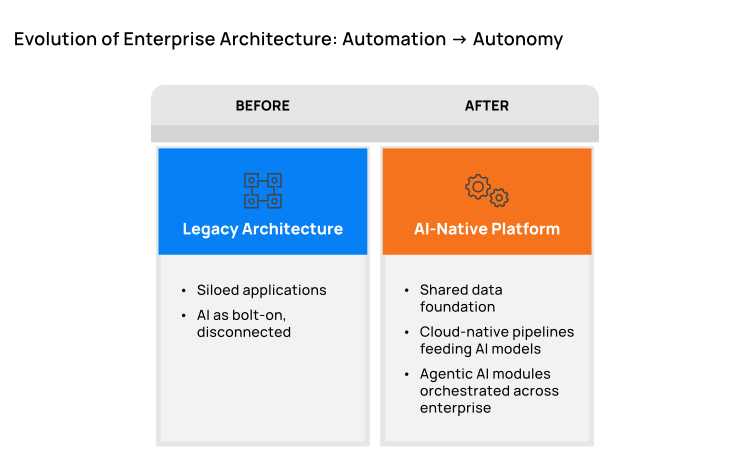
Product advancement in 2026 depends on a data-first approach that prioritizes simulation over physical prototyping. Most large-scale operations have actually moved away from traditional laboratory structures toward high-density compute facilities. These sites serve as the main engine for checking brand-new products, software application setups, and mechanical styles. The shift is driven by the reducing cost of specialized silicon and the increasing accuracy of physics-based designs that enable millions of iterations in a virtual environment before a single physical system is built.A basic R&D center now houses dedicated server clusters running personal large language designs. These designs are trained specifically on exclusive data to ensure intellectual property remains protected. By keeping the processing regional, companies prevent the latency and privacy risks associated with public cloud services. This regional processing capability allows engineers to query years of internal test results and style documents in seconds, successfully turning the business's history into an active part of the style process.Reliability in these systems is kept through redundant power materials and advanced liquid cooling systems. In 2026, the thermal management of a research study site is as crucial as the engineering talent itself. Without stable temperatures, the high-performance chips required for complicated simulations would throttle, slowing down the development cycle by weeks or months. Organizations focusing on Enterprise Strategic Units have found that infrastructure stability is the best predictor of meeting quarterly advancement targets.
Building Neural Architectures for Item Design
The relocation towards agentic workflows has redefined how technical teams approach problem-solving. In previous years, scientists by hand input variables into simulation software. In 2026, self-governing agents manage the optimization procedure. These representatives are configured with particular constraints-- such as weight, cost, and resilience-- and are delegated go through countless style variations. The human engineer serves as a manager, reviewing the leading three percent of results rather than performing the grunt work of variable adjustment.Neural networks used in this capacity are increasingly modular. Rather of one huge model for everything, business utilize a series of smaller, extremely specialized models. One might focus on fluid characteristics while another examines manufacturing feasibility based upon current supply chain schedule. This modularity makes it much easier to update particular parts of the system without re-training the entire structure. It likewise enables better transparency when a style fails, as the team can trace the error back to a particular model's output.Data quality remains the most significant obstacle. Artificial data has become a staple in 2026, filling the gaps where physical test information is sporadic. By utilizing generative designs to develop sensible edge cases, engineers can stress-test designs versus situations that are rare in the real world however devastating if they happen. This practice has actually caused a substantial reduction in item recalls and field failures.
Resource Management and Specialized Talent
The function of the scientist has shifted toward that of a systems architect. Proficiency in 2026 needs more than deep knowledge of a specific field like chemistry or mechanical engineering. It also requires the capability to direct AI representatives and analyze complex data visualizations. Hiring is no longer about discovering the person with the most experience in a lab, however discovering the individual who can finest handle the digital tools that run the lab.Internal training programs have actually become the main approach for talent acquisition. Because the particular tech stack of a 2026 development center is frequently proprietary, companies can not depend on universities to provide fully trained graduates. Rather, they work with for core scientific principles and then provide 6 months of intensive training on their specific AI-driven tools. This investment guarantees that the labor force understands the particular subtleties of the company's modeling software and data governance policies.Investment in Enterprise Strategic Units continues to grow as companies realize that human capital is only as efficient as the tools it handles. High-performance groups are characterized by their ability to pivot rapidly when a simulation reveals a defect. The speed of this pivot is figured out by how well the data is indexed and how easily the research study team can interact with the software development side of the organization.
Secure Data Silos and IP Security
Copyright security is the most pointed out concern for 2026 R&D heads. As designs become more capable, the danger of a data leak increases. If a rival gains access to an exclusive design, they get more than simply a set of plans. They get the entire reasoning used to produce those blueprints. To combat this, numerous companies use "air-gapped" R&D networks that have no physical connection to the outdoors internet.Data obfuscation techniques are also standard. When data relocations between departments, it is often encrypted or removed of particular identifiers that might reveal a task's ultimate goal. Just at the highest levels of the innovation center is the full photo visible. This compartmentalization prevents a single security breach from compromising the entire roadmap.The use of blockchain for audit tracks has actually seen a resurgence in 2026. Every modification to a design file and every timely provided to a research representative is recorded on a private journal. This produces an unalterable history of the item's advancement. If a patent conflict emerges, the company can supply a minute-by-minute record of the discovery procedure, proving the originality of their work.
The Function of Simulation-First Engineering
Simulation-first engineering is not simply a technique however a requirement in the 2026 market. Customers expect faster update cycles and greater levels of personalization. To fulfill these needs, companies need to have the ability to branch their designs rapidly. A car manufacturer may produce fifty different suspension tunes for a single model to match various local terrains. This would be difficult without automated simulation.Digital twins work as the centerpiece of this technique. A digital twin is a virtual representation of a physical item that is upgraded with real-world data in real-time. In 2026, these twins are used throughout the entire item lifecycle. Even after an item is offered, information from its sensors is fed back into the R&D center to enhance the next generation. This creates a continuous loop of enhancement that was previously impossible.The accuracy of these twins has reached a point where they can predict wear and tear within a five percent margin of error over a ten-year span. This level of precision permits thinner margins in product use, decreasing expenses and environmental impact without compromising safety. Business that mastered these simulations early in 2026 now hold a significant lead in making performance.
Hardware Velocity in the R&D Lab
Standard CPUs are seldom used for the heavy lifting in modern innovation centers. Rather, Tensor Processing Units and Field Programmable Gate Arrays are the norm. These chips are created to deal with the specific types of math utilized in neural networks and physics engines. By utilizing specialized hardware, groups can finish in hours what utilized to take days.The expense of this hardware is considerable, leading to a pattern of "hardware sharing" within large corporations. A department in the local market may utilize a compute cluster in the early morning, while a division in a various time zone takes control of the capacity in the night. This makes sure that the costly silicon is never sitting idle. Effective scheduling of calculate resources is now a core competency for R&D managers.Maintenance of these systems requires a brand-new type of specialist. These individuals should understand both the hardware layer and the software application stack. If a simulation is running slowly, the issue might be a malfunctioning cooling pump or a sub-optimal code bit. The ability to detect concerns throughout these different layers is a rare and important ability set in 2026.
Communication Throughout Distributed Research Study Teams

While the calculate might be centralized, the skill is frequently dispersed. In 2026, virtual truth is utilized for more than simply conferences. It is used for collaborative design reviews. Engineers from around the world can "stand" inside a 3D model of a turbine or a chemical plant and go over modifications as if they were in the exact same space. This spatial awareness leads to faster agreement and fewer misunderstandings compared to 2D video calls.Data visualization tools have also developed. Instead of basic charts, researchers utilize immersive environments to explore multidimensional information. They can walk through a visual representation of a high-dimensional design space, searching for clusters of effective variables. This instinctive approach to data expedition typically results in "aha" moments that would be missed out on in a spreadsheet.The integration of these tools into the day-to-day workflow has actually minimized the requirement for physical travel, though the value of the periodic in-person session remains. Most successful 2026 development strategies involve a mix of high-frequency digital cooperation and quarterly physical events at the primary research site to align on long-term goals.
Adjusting to Rapid Regulatory Changes
In 2026, policies relating to AI utilize in R&D are in a constant state of flux. Various areas have different requirements for transparency and data use. To manage this, innovation centers have incorporated "compliance representatives" into their workflows. These are specialized software application tools that keep track of the R&D procedure in real-time, flagging any potential violations of local or international law.This proactive method prevents the company from investing millions on a job that can not be legally brought to market. The compliance representatives are updated daily with the most recent legal requirements from every jurisdiction the business runs in. This is especially crucial for industries like pharmaceuticals and aerospace, where security regulations are rigorous and the cost of non-compliance is high.Ethics committees likewise play a larger role in 2026. These groups examine the objectives of the R&D center to ensure they line up with the business's stated values. As AI makes it much easier to produce effective and possibly damaging technologies, the human component of oversight is more crucial than ever. The goal is to ensure that while the tools are self-governing, the direction remains firmly in human hands.
Future Patterns in 2026 and Beyond
Looking toward the end of 2026, the focus is moving towards "zero-touch" R&D. This is a principle where the whole process from preliminary hypothesis to final style is dealt with by a chain of AI agents, with human interaction only at the very beginning and extremely end. While this is not yet a reality for many, the components are being put into place.The next significant hurdle will be the combination of quantum computing into the basic R&D stack. While still in the early stages, quantum-classical hybrid systems are beginning to reveal promise for specific tasks like molecular modeling. Companies that are currently comfy with AI-driven R&D will be the best positioned to adopt quantum tools when they become more extensively available.The centers that prosper in 2026 are those that view technology not as a replacement for human imagination however as a method to amplify it. By removing the repetitive tasks of data entry and fundamental simulation, these companies allow their brightest minds to focus on the big ideas that will specify the next decade of industry. The roadmap for 2026 is clear: purchase information, prioritize security, and build a culture that can adjust to the speed of digital experimentation.

Table of Contents
- – The Technical Foundation of Modern Innovation ...
- – Building Neural Architectures for Item Design
- – Resource Management and Specialized Talent
- – Secure Data Silos and IP Security
- – The Function of Simulation-First Engineering
- – Hardware Velocity in the R&D Lab
- – Communication Throughout Distributed Research ...
- – Adjusting to Rapid Regulatory Changes
- – Future Patterns in 2026 and Beyond
Latest Posts
Leveraging Big Data to Enhance Development Center Layouts
Handling Big Datasets in AI-Driven R&D Environments
Designing Carbon-Neutral Facilities for a Greener Tech Future
Latest Posts
Leveraging Big Data to Enhance Development Center Layouts
Handling Big Datasets in AI-Driven R&D Environments
Designing Carbon-Neutral Facilities for a Greener Tech Future